Task F, Elements of Effective Teaching that Include Risk Management and Accident Prevention
– Aeronautical Decision-Making (ADM) includes, using Crew Resource Management (CRM) or Single-Pilot Resource Management (SRM), as appropriate.
The Federal Aviation Administration (FAA) emphasizes Aeronautical Decision-Making (ADM), Crew Resource Management (CRM), and Single-Pilot Resource Management (SRM) through the DECIDE model, which treats decision-making as a skill that can be trained and repeated rather than an innate personality trait or an impulsive instinct. ADM is described as a systematic mental process for consistently identifying the best course of action in response to specific circumstances.
“Between Two Cells”
Written By R. Maclyn Stringer
“Congratulations!” I said as I high-fived the newest private pilot. Ben completed his Private Pilot check ride at an airport in Kansas, about four hundred miles east of our home base in Colorado.
After a quick and inexpensive lunch at the FBO, we checked the weather, as we always do before a cross-country flight. Everything seemed fine. As expected, it was a good day for flying. However, we both expected the usual summer weather pattern east of the Rockies: smooth flights in the morning, followed by pockets of thunderstorms developing in the afternoon as temperatures rise and the air destabilizes.
We embarked on our three-and-a-half-hour journey home in the reliable old Cessna 172R. The cross-country flight turned out to be unusually smooth, with steady air and superb visibility. Apart from some clouds overhead, flying at 4000’ AGL, we could see for hundreds of miles. Our conversation changed from what he needed for his check ride to discussing destinations where he could now fly with family and friends to enjoy $200 burgers.
About 150 miles from home over the Great Plains, we began to notice the first signs of convective activity over the horizon to the west. There was some vertical development in the distance, though nothing that appeared dangerous at this stage of our flight. Throughout the trip, we had been in contact with flight following, which seems particularly important in this desolate part of the country. As you travel west from Kansas toward the Rockies, airports become more spread out, radio communication is heard less often, and it’s crucial to know your options for alternates before they are urgently needed.
At about 80 miles from home, the radio conversations changed. We started hearing commercial traffic make PIREPS, reporting moderate turbulence one after another as they departed from Denver International, flying northeast. It was the kind of pattern where you stop hearing individual voices and start listening to the message.
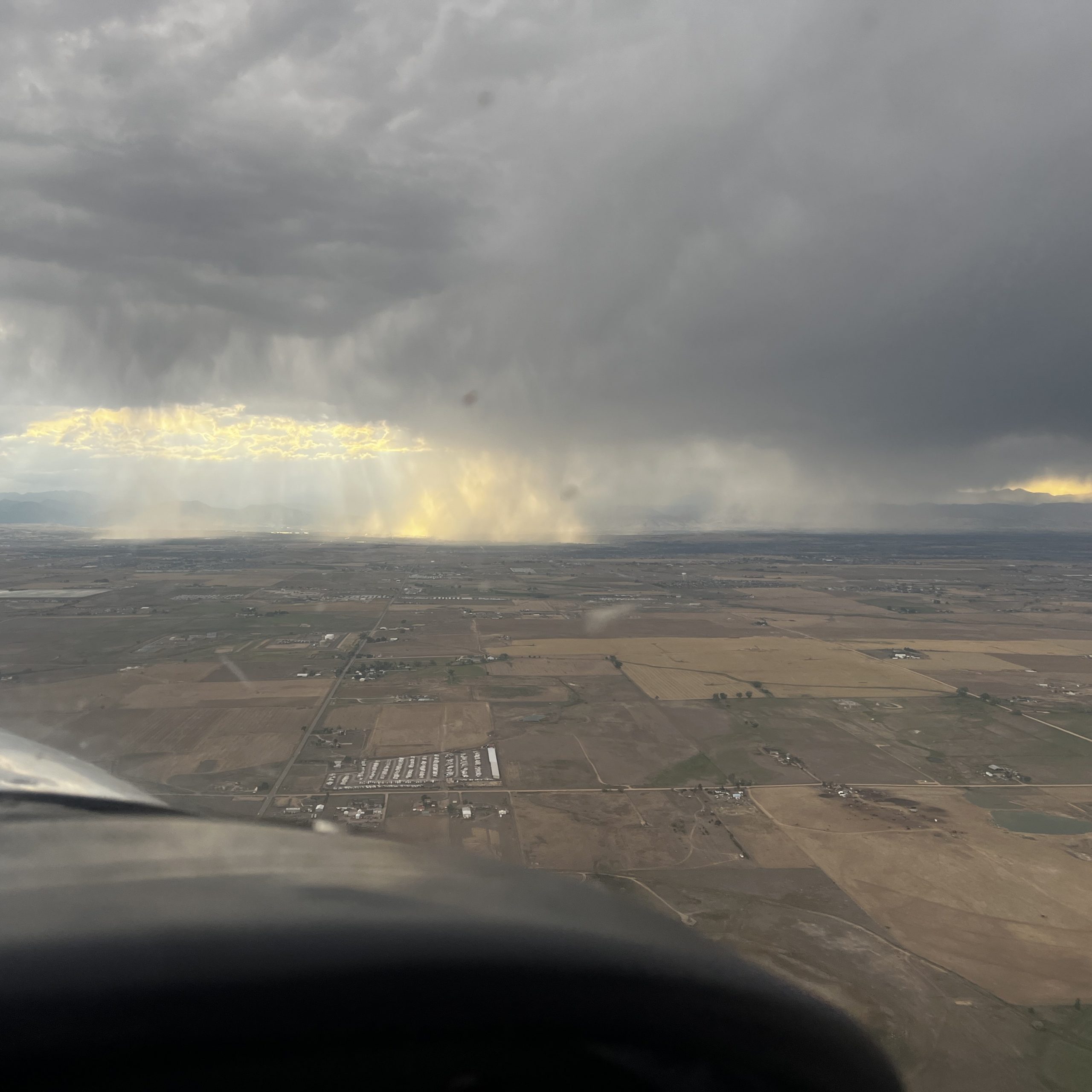
Looking out the window, we could see that our route took us south of the towering storm cell we had been monitoring. Then, something happened that changed everything: another storm cell began forming roughly forty miles southwest of the larger one. Two cells, one to the north and one to the south, with our course aligned to go directly between them.
At this moment, I became more focused on our flight than on our conversation. The FAA’s DECIDE model (Detect, Estimate, Choose, Identify, Do, and Evaluate) for Aeronautical Decision-Making started to influence my thinking.
DETECT
I took this opportunity as a teaching moment and asked Ben what he was hearing. He gave me a good summary, saying that multiple aircraft were reporting moderate turbulence from the surface through ten thousand, with several requesting deviations around the storm.
This was the moment we both recognized the change. The flight had been smooth for hours. Now we were staring at developing convection along our route, backed by repeated reports of turbulence. We could see the sun shining on the mountain, below the clouds and verga between the storm cells.
ESTIMATE
I assessed what the change could mean over the next twenty minutes, 40 miles of flight, not just what it looked like at that moment.
The gap between the cells appeared to be about forty miles wide, though we had no way of knowing the actual distance with certainty. Our aircraft was not equipped with weather radar. Although I was already making an assessment, I asked Ben for his opinion to continue the teaching moment. Ben knew the weather and the aircraft’s performance. He told me, “At our current ground speed, we’d pass through the gap in roughly twenty minutes.” We also discussed what could quickly make our plan unsafe: rapidly approaching thunderstorms, shifting winds, and, worse, the possibility that the gap could narrow if the storms converge.
We acknowledged another important point: what you see isn’t the whole picture of the weather hazard. The air can become rough long before a storm looks “bad,” and a clear view of the mountains doesn’t guarantee a stable route through developing convection.
We also assessed our escape route. We could still turn back to the airport behind us, but every mile forward shrank that margin and cranked up the temptation to press on.
CHOOSE
The pressure was familiar. We’d been flying for three hours. Home was close. It would’ve been easy to let “get-there-itis” drive our decision; however, we both knew the consequences of being careless and stupid.
With proper use of Crew Resource Management (CRM), the choice became clearer. We would continue only if we could maintain safe separation from the storm cells. Success wasn’t about arriving before dark or within thirty minutes. It was simply about getting home safely, whether that meant arriving on time, later that evening, or spending the night elsewhere and getting home the next morning.
IDENTIFY
We identified the actions available to us and the constraints on them.
Our realistic options were to continue toward the gap while continuously monitoring storm behavior and maintaining significant lateral separation from both cells, or to turn around and return to the airport behind us, while the option was still available. There was no practical “go north” or “go south” alternative. Both storms were so large that navigating around their edges was not possible.
I have completed this cross-country flight several times. Normally, I keep our altitude and fly north around the Bravo. This time, we descended to 2000’ AGL to stay beneath the shelf and take the most direct heading between the cells. ATC checked in on us and asked about flight conditions. We reported that the flight was smooth at 7500 feet and that we had both cells in sight. The controller confirmed the big-picture weather. There was a large cell to our north and a rapidly developing cell to our south. Nothing in the call suggested convergence, but we didn’t treat that as reassurance. We treated it as was, good information.
We discussed and identified our triggers to change course. If the gap in the weather narrowed, if we encountered significant turbulence, or if either cell began developing obvious growth towards the gap, we would execute an immediate reversal to the last alternate airport we identified earlier. We were not committed to continuing west.
DO
We decided to continue, prepared to bail and turn around immediately if necessary. Visually, the northern cell appeared to be moving north quickly, while the southern cell was in the process of rapid vertical development however, it looked mostly stationary. We maintained roughly twenty miles of spacing between cells, and even at the time, we recognized it was close to the minimum we were willing to accept.
Within fifteen minutes, we had left both the cells behind, flying smoothly towards home under clear blue skies as the sun lowered over Colorado’s beautiful Front Range. Looking eastward, we observed the cells developing. From our vantage point and confirmed by the map on our mobile device, it appeared that the cells were converging over the small airport that had been our probable turn-back point earlier.
EVALUATE
We safely returned home and reviewed our flight, gaining important insights. Based on our knowledge at the time, we selected a course of action we believed was safe. We carried out our plan while monitoring the weather, listening to ATC, and recognizing that our personal minimums required us to adjust our flight. We also identified areas where we can improve. Although the weather seemed fine before departure, we didn’t maintain situational awareness or update our plan as afternoon clouds began to form. By working together, we enhanced our understanding of the weather, which will be crucial for future flights.
Leave a Reply