Tag: FAA Fundamentals of Instruction (FOI)


  • Task B.  The Learning Process
    – The Laws of Learning

    The Federal Aviation Administration’s (FAA) Flight Instructor, Airman Certification Standards (ACS) treats the Laws of Learning as required knowledge for any initial flight instructor applicant.

    The FAA expects CFIs to have a solid understanding of how learning occurs, as the quality of instruction directly impacts training results and safety. Additionally, the FAA associates the learning process with risk management factors such as insufficient or incomplete instruction, low learner motivation, and the identification and correction of learner errors.

    REEPIR is an acronym for the FAA’s six Laws of Learning: readiness, primacy, exercise, effect, intensity, and recency.

    “Fresh Start”

    Written By R. Maclyn Stringer

    As a senior and experienced flight instructor, I was asked to take on a student who had been struggling with his flight lessons for some time. Alex’s commitment to flight training was inconsistent, averaging three lessons per month, and he had gone through three instructors over the past two years. Like most instructors, two of them left for airline jobs, leaving little continuity in Alex’s instruction. His latest instructor, Austin, realized he was not a good fit for Alex. Austin pulled me aside, explained Alex’s situation, and thought I would be able to work well with him. This was mature thinking on Austin’s part, given that he was a relatively young flight instructor. He understood that not all personalities work well together in a training environment, especially when teaching an older student.

    I met Alex and learned that he was fifty years old and a successful mechanical engineer. Watching him pre-flight the aircraft, I noticed that he was methodical and precise. He talked me through what he was doing as he went through his flow, reciting the checklist without hesitation, ensuring every detail was complete. For all intents and purposes, I believed Alex was ready to learn.

    Readiness: Learning works best when the learner is prepared, motivated to learn, and has the prerequisite knowledge and skills.

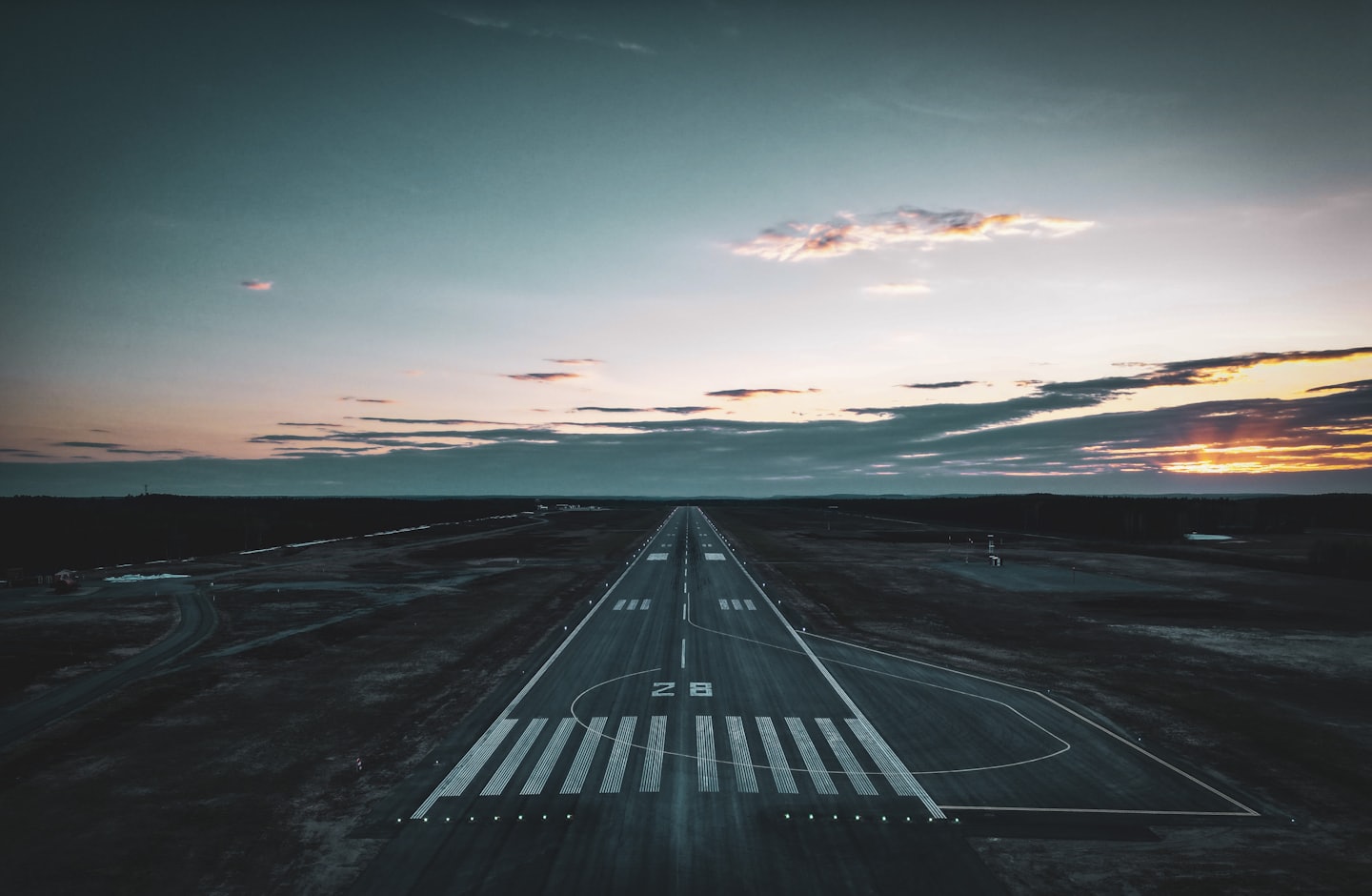
    We departed our local towered airport and flew towards an uncontrolled airport we often use for pattern work and landings. About five miles out, we descended towards the pattern when Alex jokingly told me I was in for a ride and explained that he had difficulty landing. A fact I was already aware of, thanks to Austin briefing me.

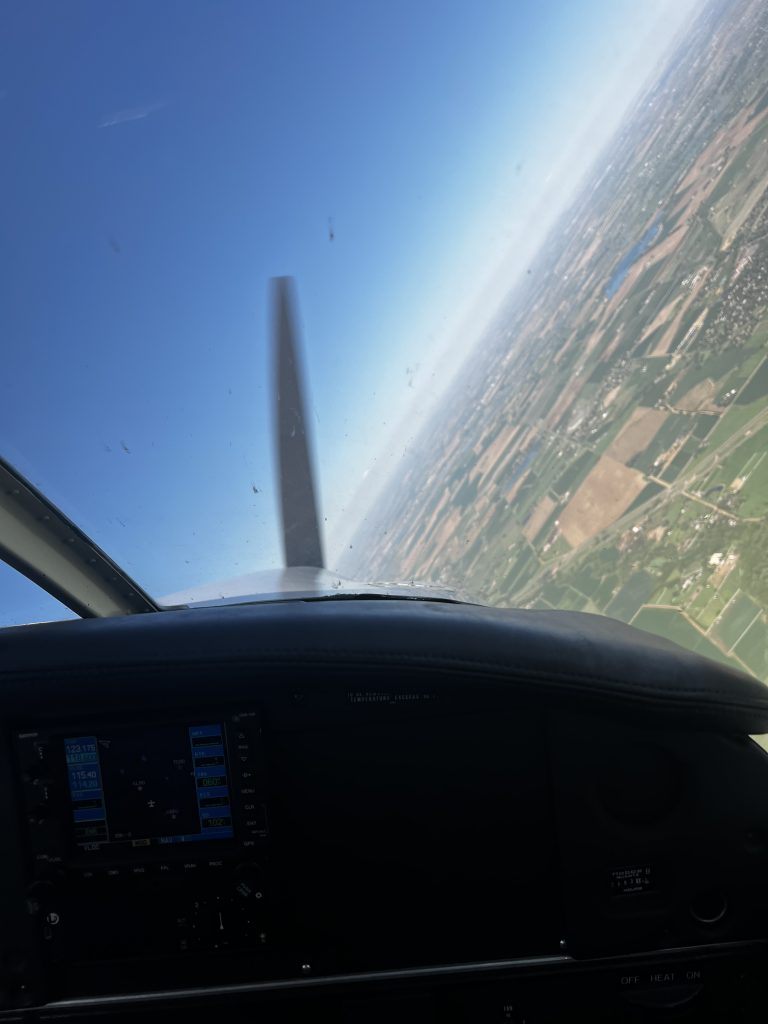
    Our approach was fine. Downwind, abeam the numbers, Alex pulled the throttle back to our descent power setting, slowed the aircraft to a proper air speed, turned base, then started messing with the throttle. In and out the throttle went as we turned towards final. I observed the vertical speed indicator fluctuate between a 100-foot climb and a 500-foot descent as he approached the runway.

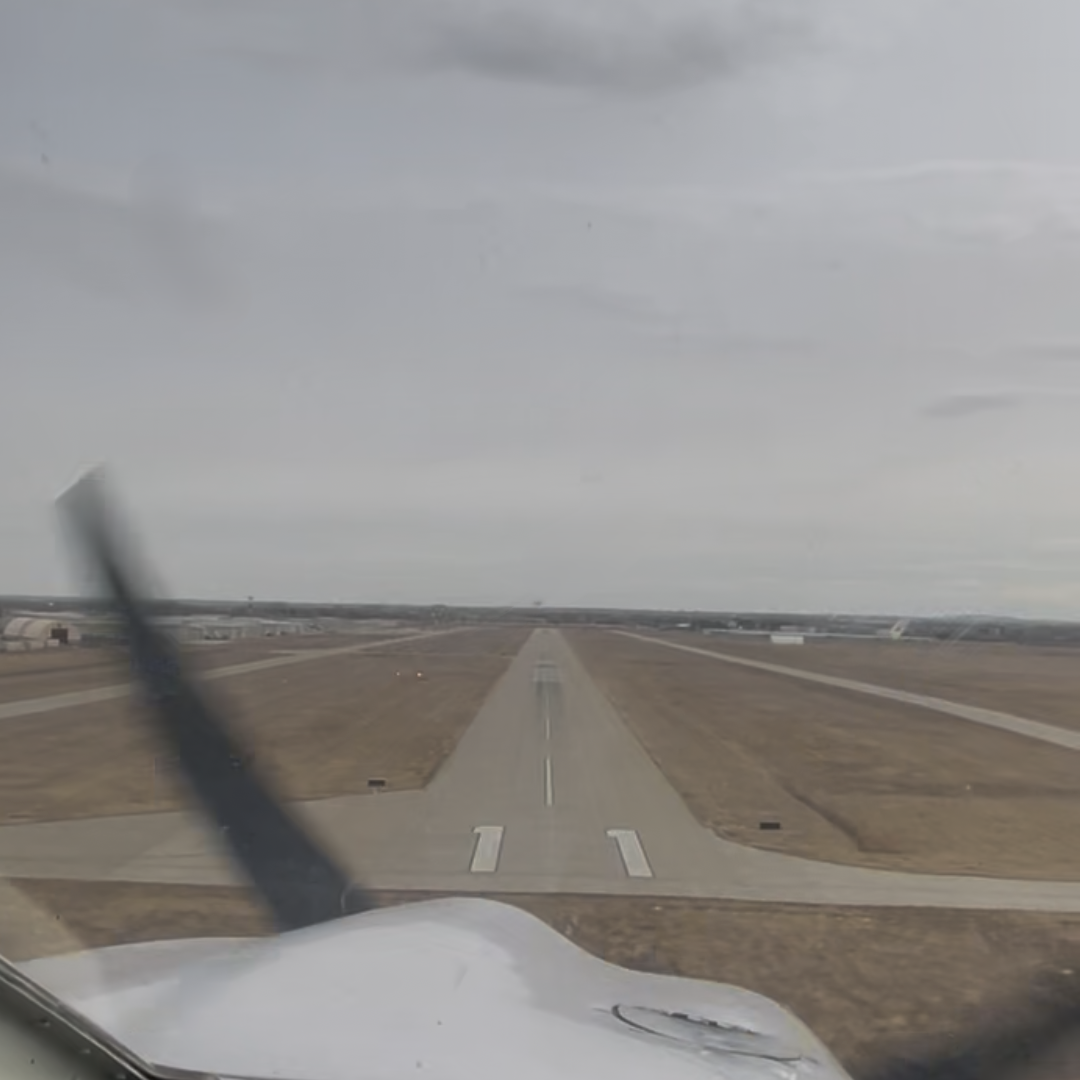
    As we approached the threshold, I guarded the yoke with my right hand, as I usually do with new students, prepared to grab it in an instant while my left hand would cram the throttle full forward and go around.

    As the nose of the airplane tilted up and down above the runway, I lightly grabbed the yoke to assist with the landing. We hit the runway and bounced, then reestablished the airplane to the centerline, and I said, “Flaps retract, full throttle.” We raced down the runway, and Alex lifted our plane off the ground like a pro. In my mind, I quickly understood what Austin tried to explain. Alex could not land an airplane to save his life.

    As we turned crosswind, I looked towards Alex and asked, “Was that a typical landing?” Alex responded, “Yes. I do not get it. I cannot land an airplane.” I could see the look of frustration and disappointment on his face. We turned downwind, and he said, “I practice landings all the time on my simulator at home, and they work out just fine. But I cannot get it to work in the actual airplane.” I noticed an angry tone in his voice, not towards me but towards the situation and himself. I thought, perhaps Alex is not ready to learn. A student is not mentally ready to learn when they are frustrated.

    “Alex, I’m going to demonstrate a landing, and I want you to just observe. Don’t touch the controls. Don’t try to memorize every movement. Just feel what I and the airplane are doing.” I took the controls and guided us through the approach. As we descended toward the runway, I narrated every movement and sensation I felt, along with everything I saw out the window, hoping he would comprehend just some of what I was doing and saying.

    After landing and reconfiguring for takeoff, I said, “Your aircraft,” and we continued down the runway. Alex took the controls, and we lifted off the ground in another perfect rotation and climb out.

    As we continued downwind, Alex explained, “I see what you did, and I do it that way on my simulator, and it works out fine. I’m aiming down the runway as if I were looking through a rifle scope, shooting towards the end of the runway.” “A rifle scope?” I responded. “We do not want to aim down the runway as if we were looking through a scope. If anything, it is like shooting a shotgun. You need to see the whole picture. On final, pick an aiming point and keep it steady in the windshield. Then, as you transition to the flare, lift your eyes farther down the runway. Use your peripheral vision to see the runway edges rise, feel the airplane settling, and keep the centerline pinned.” Alex nodded. “And stop using your simulator to practice landings. The site picture is nothing like what you are attempting to see in the real airplane.”

    “Your turn,” I said. “But this time, I want you to forget everything you think you know about landing. We’re starting fresh. This is your first landing lesson. What we are about to learn will be the foundation of every landing you ever make.” I thought to myself about the principle of primacy.

    Primacy: What is learned first leaves a strong, durable impression, so it must be taught the first time correctly. Relearning later is harder and can be confusing.

    Alex had been teaching himself bad habits, and no one had held him accountable for his actions. We had to erase what he thought he knew and begin fresh. We needed to override those memory patterns with correct ones, and the best way to do that was to treat this as a completely new beginning.

    As Alex turned from downwind to base, again, he fiddled with the throttle. In and out, he pushed and pulled the throttle lever. I said, “Leave the throttle alone, set the proper power setting, and let the airplane fly its path to final, then, if you need to add some power, add some. I tell you when you can touch the throttle.” As we approached short final, I told him he could use the throttle when he thought he needed it. Alex hit the runway hard, and we bounced again before landing. I thought to myself, if I were a cat, I would only have eight lives left. For the next hour, we continued to exercise and embrace slam-and-goes.

    Exercise: Connections strengthen with practice and weaken when practice stops, and is most effective when tied to real-world application, not rote repetition.

    “Practice makes perfect,” I told him. Sometimes Alex would dive to the runway, and other times we would float a third of the way down the runway before he or I would say, ‘going around.’ We spent the next few lessons repeating landings and other maneuvers. I do not recall how many touch-and-goes we completed before we finally saw improvements over previous landings.

    Students can see when an instructor is hovering, ready to grab the controls, and it can subconsciously undermine their confidence in their own ability. I wanted to give him confidence that he could land without my hands, prepared to grab the yoke at the last second. We descended towards the runway. Nervously and wide-eyed, I kept my hands on my legs with my feet just above the rudder pedals and my mouth shut. We hit hard, slamming the aircraft onto the runway. One of the hardest landings I have allowed a student to make, but he landed it without a bounce, without a float. Alex retracked the flaps, added full power, and we rose off the ground. I saw in his face the joy of accomplishment. He landed the airplane without the assistance or nagging of an instructor. Though I could not help but laugh internally, thinking that he did not take all nine lives today. The effect of the good landing is what Alex needed to build confidence.

    Effect: Outcomes drive repetition; satisfying results are repeated, while unpleasant results are avoided.

    “Alex, to keep your landings in good shape, we should train your brain soon to preserve muscle memory. You need to practice it or risk forgetting. Can you fly tomorrow?” I asked.

    Alex responded, “Yes, I would love to.”

    The next morning, Alex and I returned to the sky and not just to land at one familiar airport. This time, I directed Alex to navigate our way to five other airports, then back to our home airport. Six different runways. Each approach gave Alex another opportunity to land the airplane. We were not just practicing landing; we were practicing to land in real-world situations. Alex was beginning to feel what it was like to enjoy piloting an airplane rather than just learning. It was now purposeful.

    Each airport we visited had different dimensions. During one of our landing attempts, Alex reverted to his bad habits, pushing and pulling the throttle in and out as we descended. The site picture was different. This runway was much narrower than the others, 40 feet wide compared to the 100-foot-wide runway at our home airport. We approached a little fast, the main hit hard, followed by the nose. We bounced. The airplane went back up. Alex attempted to push the nose down. I grabbed the yoke, held it steady, said, “Going around,” and pushed the throttle forward.

    Alex looked at me, shocked, and said, “I do not know what went wrong.” I responded, “That was a bounce likely to turn into a porpoise, and if not managed properly,” as we ascended from the runway. “Trying to correct that bounce usually worsens it, potentially causing a series of violent ups and downs, and if not immediately corrected, could lead to nose gear collapse or a prop strike.” I saw fear in Alex’s eyes. The intensity of this moment would stay with him forever.

    Intensity: Vivid, realistic, meaningful experiences teach more than routine or boring ones.

    As a CFI, I appreciate the moments when the student and I face an intense situation together during flight training, rather than when they are flying solo. If they were to experience an event like that without an experienced pilot next to them, they might not be able to correct the situation quickly enough. By going through the event together, they might have a better chance of recognizing it as it happens to them in the future.

    Alex and I spent the next couple of weeks developing the mental picture and retraining his mental primacy to maneuver the airplane for a successful landing. We exercised his brain and muscles to see the correct sight picture, fly the proper approach, and complete good landings, which had a positive effect on his confidence. No more intense moments to be had while we trained, one was enough.

    The recency of several perfect landings made me realize that it was time for Alex to solo. He did not know he would be soloing that day. I asked, “Are you ready to do this?” Alex asked, “Today?” I nodded, and he said, “Yes.” We completed the required endorsements in his logbook, and I hopped out of the airplane. I watched Alex take to the sky alone, making three trips around the pattern and landing each time smoothly.

    Recency: The most recently learned items are remembered best and recall fades with time.

    It was not long after that Alex earned his Private Pilot Certificate. When he did, he thanked me for taking the time to work with him, for managing his struggles, and for instilling the confidence that he could land an airplane and become a private pilot. He also handed me a bottle of Macallan 15, a special touch for a passionate flight instructor.

    FOI Stories
  • Task F, Elements of Effective Teaching that Include Risk Management and Accident Prevention

    Aeronautical Decision-Making (ADM) includes, using Crew Resource Management (CRM) or Single-Pilot Resource Management (SRM), as appropriate.

    The Federal Aviation Administration (FAA) emphasizes Aeronautical Decision-Making (ADM), Crew Resource Management (CRM), and Single-Pilot Resource Management (SRM) through the DECIDE model, which treats decision-making as a skill that can be trained and repeated rather than an innate personality trait or an impulsive instinct. ADM is described as a systematic mental process for consistently identifying the best course of action in response to specific circumstances.


    “Between Two Cells”

    Written By R. Maclyn Stringer

    “Congratulations!” I said as I high-fived the newest private pilot. Ben completed his Private Pilot check ride at an airport in Kansas, about four hundred miles east of our home base in Colorado.

    After a quick and inexpensive lunch at the FBO, we checked the weather, as we always do before a cross-country flight. Everything seemed fine. As expected, it was a good day for flying. However, we both expected the usual summer weather pattern east of the Rockies: smooth flights in the morning, followed by pockets of thunderstorms developing in the afternoon as temperatures rise and the air destabilizes.

    We embarked on our three-and-a-half-hour journey home in the reliable old Cessna 172R. The cross-country flight turned out to be unusually smooth, with steady air and superb visibility. Apart from some clouds overhead, flying at 4000’ AGL, we could see for hundreds of miles. Our conversation changed from what he needed for his check ride to discussing destinations where he could now fly with family and friends to enjoy $200 burgers.

    About 150 miles from home over the Great Plains, we began to notice the first signs of convective activity over the horizon to the west. There was some vertical development in the distance, though nothing that appeared dangerous at this stage of our flight. Throughout the trip, we had been in contact with flight following, which seems particularly important in this desolate part of the country. As you travel west from Kansas toward the Rockies, airports become more spread out, radio communication is heard less often, and it’s crucial to know your options for alternates before they are urgently needed.

    At about 80 miles from home, the radio conversations changed. We started hearing commercial traffic make PIREPS, reporting moderate turbulence one after another as they departed from Denver International, flying northeast. It was the kind of pattern where you stop hearing individual voices and start listening to the message.

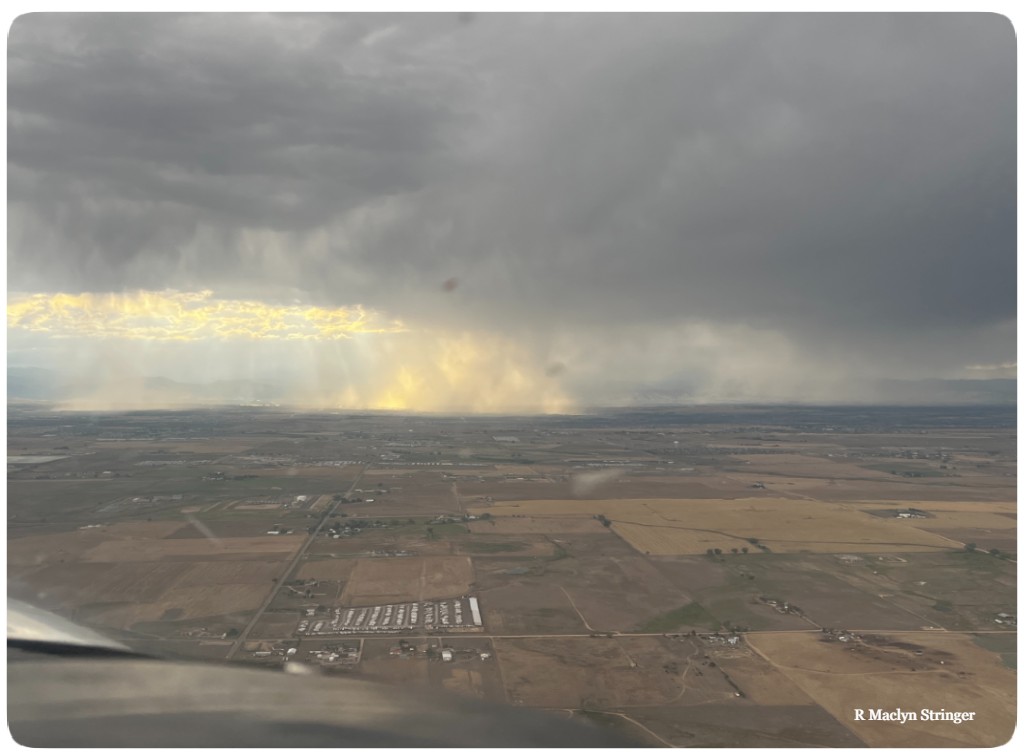
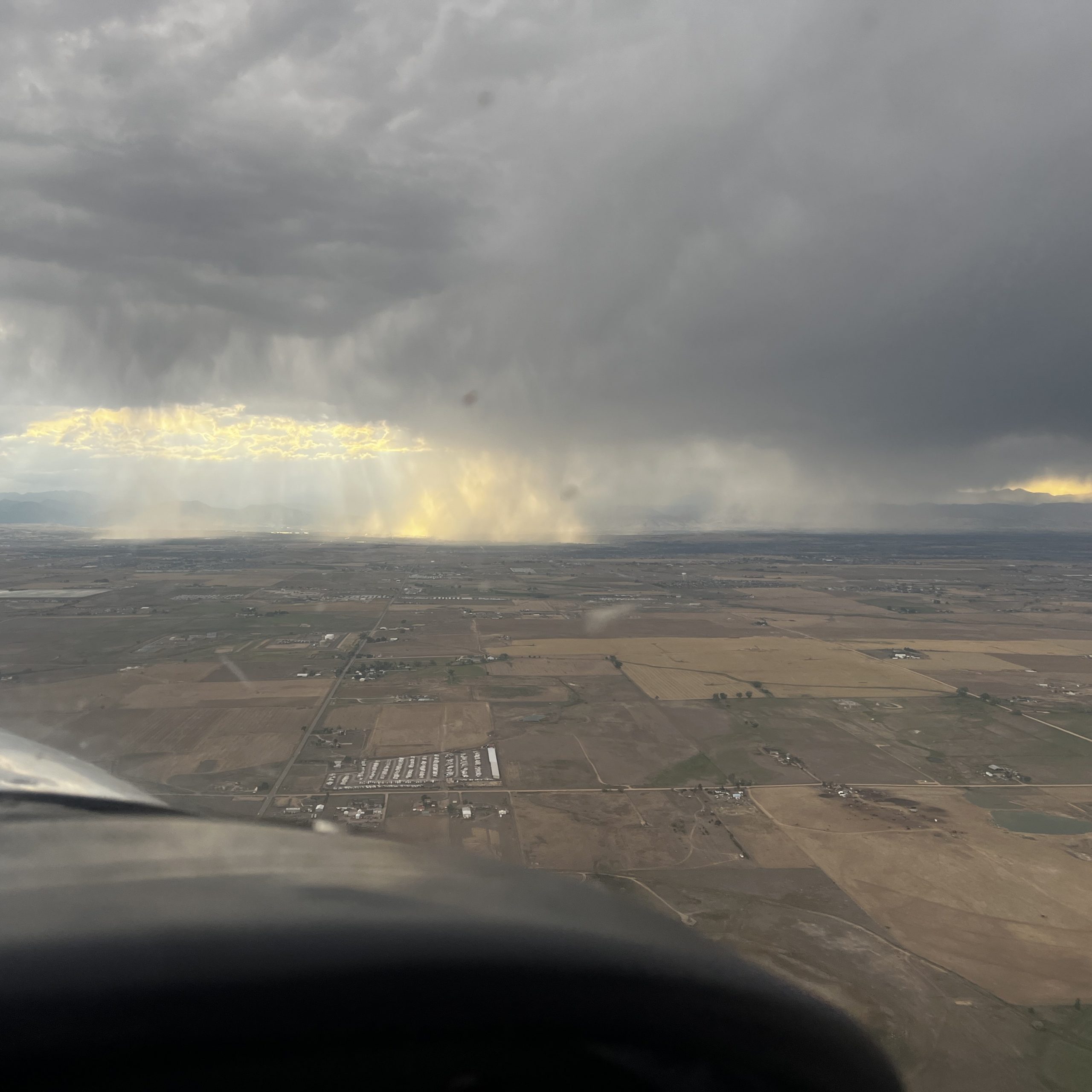
    Looking out the window, we could see that our route took us south of the towering storm cell we had been monitoring. Then, something happened that changed everything: another storm cell began forming roughly forty miles southwest of the larger one. Two cells, one to the north and one to the south, with our course aligned to go directly between them.

    At this moment, I became more focused on our flight than on our conversation. The FAA’s DECIDE model (Detect, Estimate, Choose, Identify, Do, and Evaluate) for Aeronautical Decision-Making started to influence my thinking.

    DETECT

    I took this opportunity as a teaching moment and asked Ben what he was hearing. He gave me a good summary, saying that multiple aircraft were reporting moderate turbulence from the surface through ten thousand, with several requesting deviations around the storm.

    This was the moment we both recognized the change. The flight had been smooth for hours. Now we were staring at developing convection along our route, backed by repeated reports of turbulence. We could see the sun shining on the mountain, below the clouds and verga between the storm cells.

    ESTIMATE

    I assessed what the change could mean over the next twenty minutes, 40 miles of flight, not just what it looked like at that moment.

    The gap between the cells appeared to be about forty miles wide, though we had no way of knowing the actual distance with certainty. Our aircraft was not equipped with weather radar. Although I was already making an assessment, I asked Ben for his opinion to continue the teaching moment.  Ben knew the weather and the aircraft’s performance. He told me, “At our current ground speed, we’d pass through the gap in roughly twenty minutes.” We also discussed what could quickly make our plan unsafe: rapidly approaching thunderstorms, shifting winds, and, worse, the possibility that the gap could narrow if the storms converge.

    We acknowledged another important point: what you see isn’t the whole picture of the weather hazard. The air can become rough long before a storm looks “bad,” and a clear view of the mountains doesn’t guarantee a stable route through developing convection.

    We also assessed our escape route. We could still turn back to the airport behind us, but every mile forward shrank that margin and cranked up the temptation to press on.

    CHOOSE

    The pressure was familiar. We’d been flying for three hours. Home was close. It would’ve been easy to let “get-there-itis” drive our decision; however, we both knew the consequences of being careless and stupid.

    With proper use of Crew Resource Management (CRM), the choice became clearer. We would continue only if we could maintain safe separation from the storm cells.  Success wasn’t about arriving before dark or within thirty minutes. It was simply about getting home safely, whether that meant arriving on time, later that evening, or spending the night elsewhere and getting home the next morning.

    IDENTIFY

    We identified the actions available to us and the constraints on them.

    Our realistic options were to continue toward the gap while continuously monitoring storm behavior and maintaining significant lateral separation from both cells, or to turn around and return to the airport behind us, while the option was still available. There was no practical “go north” or “go south” alternative. Both storms were so large that navigating around their edges was not possible.

    I have completed this cross-country flight several times. Normally, I keep our altitude and fly north around the Bravo. This time, we descended to 2000’ AGL to stay beneath the shelf and take the most direct heading between the cells. ATC checked in on us and asked about flight conditions. We reported that the flight was smooth at 7500 feet and that we had both cells in sight. The controller confirmed the big-picture weather. There was a large cell to our north and a rapidly developing cell to our south. Nothing in the call suggested convergence, but we didn’t treat that as reassurance. We treated it as was, good information.

    We discussed and identified our triggers to change course. If the gap in the weather narrowed, if we encountered significant turbulence, or if either cell began developing obvious growth towards the gap, we would execute an immediate reversal to the last alternate airport we identified earlier. We were not committed to continuing west.

    DO

    We decided to continue, prepared to bail and turn around immediately if necessary. Visually, the northern cell appeared to be moving north quickly, while the southern cell was in the process of rapid vertical development however, it looked mostly stationary. We maintained roughly twenty miles of spacing between cells, and even at the time, we recognized it was close to the minimum we were willing to accept.

    Within fifteen minutes, we had left both the cells behind, flying smoothly towards home under clear blue skies as the sun lowered over Colorado’s beautiful Front Range. Looking eastward, we observed the cells developing. From our vantage point and confirmed by the map on our mobile device, it appeared that the cells were converging over the small airport that had been our probable turn-back point earlier.

    EVALUATE

    We safely returned home and reviewed our flight, gaining important insights. Based on our knowledge at the time, we selected a course of action we believed was safe. We carried out our plan while monitoring the weather, listening to ATC, and recognizing that our personal minimums required us to adjust our flight. We also identified areas where we can improve. Although the weather seemed fine before departure, we didn’t maintain situational awareness or update our plan as afternoon clouds began to form. By working together, we enhanced our understanding of the weather, which will be crucial for future flights.

    FOI Stories

  • Task A.  Effects of Human Behavior and Communication on the Learning Process

    Teaching the adult learner

    The FAA emphasizes the importance of the instructor-learner relationship with adult learners to ensure training is founded on respect, clear standards, and intentional instruction. Instructors are responsible for assisting learners, delivering comprehensive instruction, training to established standards, highlighting positives, and minimizing frustration. Additionally, the ACS promotes scenario-based, application-driven training to enhance skill development and assess risk management in realistic contexts.


    “Answering The Why in the Sky”

    An Adult Learner’s Cross-Country Lesson in Workload Management

    Written By R. Maclyn Stringer

    The flight school scheduled a discovery flight with Landon, and I was the CFI assigned to take him up. When he walked into our pilot’s lounge with tattooed arms, wearing a T-shirt, jeans, and boots, I made a quick assumption about who he was. Laid back, maybe rough around the edges, the kind of guy who rode a cruiser and did not have much patience for details. Within ten minutes, I learned my first lesson of the day: beware of first impressions.

    I found out he was forty-five, worked as a physical therapist, and had become interested in aviation a few years earlier, but life had gotten in the way of living. He had a new career, altered finances, and the responsibilities of a single father to his sixteen-year-old daughter; he now had the means to take flight lessons for both himself and his daughter.

    I have instructed students ranging from fifteen to seventy-three years old. The FAA’s guidance on teaching emphasizes that adult learners are not just “older versions” of teenagers. I consider older learners to be those over thirty who bring many years of experience and specific expectations into learning.

    Young learners often accept the learning process as presented. They do the repetitions, take the coaching, and let results prove the method, which is how Landon’s daughter took instruction. I would tell her what to do, and she just did it.

    Adult learners want to gain knowledge in ways that are relevant to reaching their goals. They value their independence, not out of stubbornness, but because they’ve spent many years making their own choices. Respect is also crucial for adult learners. While all learners need respect, adults are susceptible to anything that might threaten their competence or self-esteem.

    From Landon’s first lesson, he was ready to learn and excited to climb into the aircraft first thing in the morning. He arrived prepared, focused, and committed.

    During the primary flight lessons, he took instructions well. He listened and performed the tasks as I taught them. He would occasionally ask questions to understand the rationale for practicing the maneuver. He wanted to know why we did it that way and how it fit into the bigger picture. Landon was a perfect example of an adult learner who needed a careful balance between instruction and respect.

    Initially, repeating basic flight maneuvers and tirelessly completing touch-and-goes didn’t bother him, but over time, irritation began to show. I noticed that he would sigh when I mentioned why we were doing something or calling out “air speed” on the base to final turn. Glance away, sometimes rolling his eyes when I corrected him. He would tighten his voice when I repeated a point he believed he already understood. He started saying things like, “I know,” or “You don’t have to tell me that again,” or “I was going to do that next,” even when I could see clearly that it was not going to be done.

    Repetition, as every instructor knows, can sound like nagging when the student has already intellectually learned the concept. From his perspective, it felt like I was talking down to him. I was not, but perception matters.

    Here is the problem: flying is not just knowledge. It is coordination. It is timing. You can understand a procedure in one lesson and still need ten more lessons before your hands and feet perform consistently. You cannot reason your way into a perfectly timed flare. You cannot “logic” your way into coordinated turns if your feet have not yet learned how much pressure to apply to the rudder. And you especially cannot perform the physical task well when your mind is focused on the mental aspects of flying, maintaining altitude, navigating straight and level, and communicating with ATC or those other pilots in a non-towered environment.

    Landon was sharp. He grasped information quickly. He could visualize airspace, predict what ATC might say, and explain the purpose of procedures with the clarity of someone who educates patients for a living. But this was done in a comfortable, familiar environment.
    That mismatch is where adult learners can get frustrated. Their mind feels ready, but their muscle memory is still developing.

    As I became more aware of the tension between Landon and me, I thought about the aggravation I had in my own training as an adult learner with a young instructor. My thoughts turned to my CFI training and the Flight Instructor’s Handbook. The book emphasizes that effective teaching with adult learners goes beyond simply conveying information; it involves shaping the learning environment to keep them motivated, engaged, and progressing toward their objectives. The cohesive relationship between the instructor and learner is an integral component of the training process.

    I decided it was time for a reality check. Landon needed a lesson that would let the real world of aviation do some of the teaching. I scheduled a cross-country flight for the two of us to give Landon firsthand experience with the full responsibility of flying and serving as the pilot in command. This included navigation, radios, entering and exiting the pattern, adapting to different environments, and making continuous decisions. My aim was for him to understand why the fundamentals are essential for a safe flight.

    During our briefing, I clearly outlined the objective. “Today isn’t about perfection,” I told him. “It’s about awareness. It’s about recognizing how many factors you need to manage and learning how to stay ahead of the airplane.” I explained that we would fly to several airports and gave him the name of each. Some were familiar, others new. “You will be the pilot in control, while I remain the pilot in command. You’ll handle navigation and communication both in and out of the airports. If you have questions, ask me.” I wanted to stress that I was not trying to belittle him. He nodded confidently, but I noticed a hint of skepticism, the part of him still believing he was closer to passing the check ride than I thought. I had already completed our flight plan earlier, expecting him to suggest we needed to do one, but he didn’t. He was ready to fly.

    We departed from our home towered airport. He performed all the tasks as required and did them well. The radio communications were smooth, and other than a couple of minor altitude fluctuations, he kept the airplane in straight-and-level flight. We entered the familiar pattern at a close non-towered airport, and after a little float past the thousand-footers, the airplane came down smoothly.

    Then we moved to another non-towered airport further away from home that he had never been to. This is where I started to see the shift in his mental workload. At twenty-five miles out, I asked, “What should we be doing?”

    After a brief time for him to think, Landon responded, “Weather.”
    “Good, okay, let’s get it.” Landon looked down and fumbled with his iPad, searching for the radio frequencies for the new airport. I watched him put his head down to scan the chart, then look outside, then back to the chart. Every time his head dropped inside to read the EFB, the airplane slowly banked left. I did not scold him. I just coached the priorities, saying “Altitude,” or “Watch your bank.”

    “I should have done this while on the ground.” He said. I simply responded, “Yep.”

    After he got the weather, I asked, “What runway and how are we going to enter the pattern for this airport?” Now he had to visualize an unfamiliar pattern, interpret what other aircraft were doing without ATC guidance, and manage his own radio calls. The mental workload changed, increased, and became more stressful.

    The other aircraft were flying around like gnats, which is normal at this airport. This particular airport has two runways that do not intersect. Pilots land on the north-south runway and the east-west runway simultaneously. The airport has a reputation for cowboys running wild while instructors try to make sense of the insanity.

    “It looks like people are using both runways,” Landed said, puzzled. I nodded. “Yes, they do. You need to state your intentions and keep your head on a swivel. You do not want your aircraft in the same airspace as another. That will make for a bad day.”

    He made radio calls, stumbling over his words, trying to explain how he was going to enter the downwind at a forty-five, going south, while looking for the straight in traffic coming from the west, with another announcing they were six miles south on a practice RNAV approach. We made the landing, and the taxi back felt slightly less confident. I could see his mind juggling what he had just done and what he had to do. We stopped, and I told him the next airport. I explained that it was towered, but a different kind of tower. This time, he made a plan for getting there. “That airport is only twenty miles away.” He said.

    “Yup, about ten minutes in the air,” I responded.
    He examined the airspace and programmed the frequencies into the avionics. We departed this airport and within a few minutes reached cruise altitude of two thousand feet AGL. He made his last call to the previous airport, then tuned the radio to the ATIS, copied the information, set frequencies, and planned the entry.

    I left out one peculiar thing about the next airport. This airport tower does not have radar. In fact, they do not even have a tower. The controllers reside in a trailer next to the runway. ATC instructs the pilot to inform them when they are five miles out, then, upon entering midfield, to look for the other aircraft in the pattern. Some may be right downwind, while others are left downwind, amid fast jet traffic.

    “Contact tower ten miles out,” I told him. He was scanning for traffic, managing airspeed, altitude, and heading; he was doing well. At ten miles out, he contacted the tower requesting a touch-and-go. ATC told him to report five miles out. At five miles out, Landon contacted the tower to inform them that we were five miles out. The tower instructed him to report midfield for right downwind.

    When we entered midfield, Landon reported our position. ATC responded, “Continue downwind, there is traffic on a two-mile final, report the traffic on final when in sight.

    What are your intentions after the touch and go?” Landon looked at me. I told him, “Depart to the south.” He pressed the mic key and told ATC, “We want to depart to the south.” ATC continued their communications with other traffic in the pattern. There was traffic on final, one on the left downwind, and us on the right downwind.

    “We have traffic in sight,” Landon said confidently.

    ATC responded, “Turn base abeam that traffic, cleared to land, after touch and go, fly runway heading one mile then left turn to the south.”
    The task saturation was setting in. This was what I wanted him to taste. He looked at me with bewilderment. I keyed up and responded, “After departure, one mile, left turn to the south.”

    “What is that?” Landon said sharply to me, with an uneasy expression on his face. He did not mean it disrespectfully. He meant it like someone under pressure trying to keep his world in order.

    I stayed calm and let him work. “You’re doing alright. Did you catch everything that was said?”

    “He spoke too fast for me to write everything down,” Landon responded.
    I explained what ATC wanted from him. He nodded in understanding. I avoided coaching him for the rest of the landing, offering only necessary comments and ensuring he made the decisions himself. Adult learners value autonomy and control, so the challenge is to provide that control while maintaining safety and boosting their confidence. He successfully executed the touch-and-go with the left turn-out.

    As we flew back to our home airport, Landon was quieter, with less chit-chatting, and focused on the flight through the busy practice area. I could see his mind thinking and perhaps realizing he had been underestimating the requirements to fly safely as a private pilot. He was still performing, but the confidence had been replaced by something more valuable, respect for complexity.

    I asked him a simple question. “How do you feel?”

    He paused. “It’s a lot,” he said finally.

    As we got closer to our home-towered airport, his confidence began to build again. The familiarity now had context. The radio calls that used to feel like isolated skills now felt like one piece of an entire system.

    After securing the aircraft, we walked back into the classroom, and I asked him to debrief the flight first. Adult learners respond well when you let them self-assess. It has a way of protecting their self-esteem and strengthening their sense of ownership. He shook his head slowly. “That was pretty stressful. I got so behind the aircraft,” he said. “Yep,” I responded. “It happens quickly. A pilot isn’t someone who knows just the procedures. It’s someone who can manage the changes, the unknown. We don’t get to pull over on the side of the road. We keep moving forward. Wait until you start flying IMC.”

    We talked about the basics, not as beginner material, but as tools to reduce workload. Proper planning, using checklists, scanning for traffic, standard radio calls, trimming the airplane, using a shorthand for notes, all those things that can feel repetitive when used consistently, will lessen the workload.

    “That’s why I continually repeat, checklist, airspeed, altitude, are you trimmed,” I said. “Not because I think you’re slow. Because repetition builds muscle memory and reliability.”

    He nodded. “I get it now.”

    The following lessons did not seem as aggravating to him. Landon did not need me to prove he was wrong. He required an authentic experience that answered his questions. Once he had that, the repetition stopped feeling like redundancy and started feeling like preparation. He understood there was a long way to go and a lot of learning to be developed before he could be the competent pilot he wanted to be.

    I try to teach adult learners in a different relationship than with young students. With adult learners, the relationship shifts from instructor-to-student to instructor-with-student, creating a cooperative learning environment. Teaching is not only about the content but also about understanding the learner, especially when the learner is an adult, motivated, capable, and determined to make sense of every step on the way to becoming a pilot.

    FOI Stories

  • TASK F: ELEMENTS OF EFFECTIVE TEACHING THAT INCLUDE RISK MANAGEMENT AND ACCIDENT PREVENTION
    – Managing hazardous attitudes

    Hazardous attitudes are among the FAA’s most critical safety concerns. While technical proficiency is essential, poor aeronautical decision-making is often rooted in hazardous attitudes that cause many preventable accidents.
    The FAA identifies five hazardous attitudes: anti-authority, impulsivity, invulnerability, macho, and resignation. Each comes with an antidote designed to reshape how pilots perceive risk and make decisions under pressure. When a pilot thinks “I can do it” or “It won’t happen to me,” they’re more likely to push weather minimums, stretch fuel reserves, or exceed their personal minimums.
    Effective instruction must address not just what pilots do, but how they think. Recognizing and correcting hazardous attitudes helps prevent accidents before they happen.


    “But I Could”

    Combating Hazardous Attitudes With Common Sense Antidotes

    Written By R. Maclyn Stringer

    When William began training with me for his private pilot certificate, we flew nearly every day to accelerate his progress. He had a goal to be a commercial pilot as quickly as possible. But then his medical exam results threw an unexpected wrench into our plans. At first, the results appeared disqualifying, triggering an FAA review that put William’s training on hold for six months. Fortunately, after further evaluation, the issue was resolved.

    Once back on the flightline, we accelerated his training, finishing everything in a few weeks. Subsequently, we coordinated his initial aviation check ride with a DPE outside our state, since arranging a timely local check ride has proven challenging.

    Our flight school is located just east of the Rocky Mountains. The DPE William identified resided about 270 nautical miles from our home airport, about a 2.5-hour flight in the Piper Archer.

    His check ride was scheduled for 8 AM. To prepare for it, William initially planned to leave the morning prior on a solo cross-country trip, allowing him enough time to arrive at his destination and then fly around the area to become familiar with the airspace.

    On the morning of his flight, William and I met at the school as strong, gale-force winds struck our region, with Mother Nature enthusiastically demonstrating her power. Sitting in the pilot’s lounge, William checked the weather online and contacted Flight Service to speak with a weather briefer, while I sat quietly across the table without intervening, listening through the speaker. The choice to go on this trip was William’s, with my endorsement, of course. William requested to make this cross-country flight solo to meet with the DPE.

    The briefer informed William that westerly winds of 40 to 50 knots with gusts above 70 were blowing from the surface through his planned altitude, extending several hundred miles to the east, and pilots had reported moderate to severe turbulence in the area. After hanging up, William reviewed his flight plan, studying his EFB and weighing different routes to his destination. He quickly ruled out flying west into the mountains or east through the plains.

    “I’m going to wait out the windy weather for a few hours,” William said. “I think I can depart around noon and still have plenty of time to fly around the area.” I nodded and said, “Let’s wait and see what happens.”

    Around noon, the winds calmed around our airport, though they remained strong to the north and across the eastern plains. As I sat on the couch, William approached me. “Mac, I can still make the flight today,” he said confidently, pointing at his tablet to describe his plan. “I’ll head east, then northwest to my destination.” “Really?” I said as I followed his finger along the route on his EFB. “That appears to be 100 miles east, then about 250 miles northwest?” I asked inquisitively, glancing up and noticing his determined expression. All morning, I noticed the hazardous attitudes building within him, fueling William’s urgent desire to fly to this check ride today. As a seasoned pilot and professional flight instructor, I understood it was time to ask questions.

    “William, is flying two extra hours in windy, moderate-to-severe turbulent conditions sensible?” I asked.

    “Two hours isn’t much,” William replied confidently. “We’ve flown together through turbulence. I can handle a few bumps.”

    I couldn’t help but think how macho (I can do it) he sounded. A 50-hour student pilot thought he could handle gusting winds, low-level windshear, and turbulence.

    “Have you considered the additional fuel and time required?” I questioned.

    “With full tanks, I can complete the flight, with the required reserve,” William said confidently.

    “How much headwind are you going to encounter when you head northwest, and how much additional time will be required?” I asked.

    William looked baffled. “I hadn’t considered that, but I’ll figure it out and update the flight plan.” Displaying the hazardous attitude of impulsivity (“Do it quickly”) in his desire to get to his destination.

    “Are you going to make this flight before sundown?” I pressed. “Have you accounted for any delays?”

    William responded, “I’ll arrive about thirty minutes before sundown.”

    “And what will you do if the sun goes down before you reach your destination? Are you allowed to fly at night as a student pilot?” I asked.

    With an assured grin, he displayed invulnerability (it won’t happen to me). “I’ll get there.” After a few seconds, he continued, “And hey, you could give me a student solo night-flying endorsement.”

    I shook my head negatively. “Good to know you recognize the regulations, but there’s no chance of you getting that endorsement from me.” Especially on an unknown cross-country flight, I thought to myself.

    “When will you become familiar with the area before your check ride tomorrow morning?” I asked.

    William shrugged, again exhibiting his macho attitude. “I don’t really need to know the area in advance. I’ll just figure it out in the morning.”

    As William and I discussed these factors, a few other instructors sat on the couch in our pilot lounge, grounded by the winds. I noticed the smirks on their faces as they listened to my questions and William’s answers.

    I looked over at them. “Do you think this is a prudent flight plan?”

    After a few chuckles, one of them said, “Not a chance.”

    William’s face fell with disappointment. He looked around towards all the instructors who were telling him he couldn’t do it. Displaying a bit of anti-authority (Don’t tell me), he insisted, saying, “But I could make it.” “Could and should are two different things,” I responded. William reluctantly decided not to take the flight. I had already known at the start of the day that he wouldn’t be going today.

    The only hazardous attitude William did not display for this flight was resignation (What’s the use). And that is because he would not be in a position to resign. I would not allow him to be in the air.

    Several days later, William made the cross-country flight, completed his check ride, and earned his private pilot certificate. He went on to earn his instrument, commercial, CFI, CFII, and MEI within 18 months in total and took a job flying Citations.

    About a year passed, and William came back to the school to visit. He and I sat down in our pilot lounge, eating some day, maybe week-old cookies, and drank coffee. “How’s life been treating you?” I asked. “Loving it,” William said with a grin. “I occasionally teach new pilots, though that’s never been my full-time gig.”

    Our conversation drifted to his attempted cross-country flight when going for his private pilot certificate. We agreed that he went through almost every hazardous attitude for one flight. “I can now see the hazardous attitudes surfacing in my students and sometimes in myself,” William admitted. “That’s the important part, being able to recognize them with the antidote and make the correction.”

    I smiled responding, “And that, my friend, is what makes you a good pilot.”

  • Task F: Elements of Effective Teaching that Include Risk Management and Accident Prevention
    – risk management

    Teaching risk management tools, including:
    a. PAVE checklist: Pilot/Aircraft/enVironment/External Pressures
    b. FRAT: Flight Risk Assessment Tools

    The FAA emphasizes Risk Management and Single-Pilot Resource Management because effective decision-making skills are fundamental to safe flight.

    The Pilot’s Handbook of Aeronautical Knowledge (PHAK) shows that pilots who receive structured Aeronautical Decision Making (ADM) and Risk Management (RM) training make significantly fewer judgment errors. This supports a key Fundamental of Instruction (FOI) principle that good judgment is a learned behavior shaped by motivation, experience, and cognitive development.

    Risk management provides a systematic method for identifying hazards, assessing risk, and applying controls throughout every phase of flight. It reinforces higher-order thinking skills, self-assessment, and sound judgment. The FAA stresses that risk cannot be eliminated, but it can be managed through deliberate analysis and informed decision-making.

    Single-Pilot Resource Management (SRM) extends these concepts to single-pilot operations, where workload, automation, navigation, and passenger pressures must be managed without crew support. Tools such as the PAVE checklist help pilots maintain situational awareness, prioritize tasks, and use available resources efficiently.Solo Cross-country: A Flight Lesson in Risk Management

    “A Flight Lesson in Risk Management”

    Written By R. Maclyn Stringer

    Ethan, a private pilot student in his mid-twenties, arrived at our flight school early in the morning, looking excited for today’s lesson.  It was not just a lesson; it was scheduled, again, to be his first cross-country solo flight. Hoping that after several delays due to weather, this was going to be the day.

    “Good morning, Ethan,” I said. “It looks like the weather is finally going to cooperate with us.”

    “I think so.” He responded with a smile.

    “Do you have your weather and navigation briefing completed as we discussed?”

    “Oh, that and more,” Ethan responded, looking towards me. “With all the delays, I have had plenty of time to create a well-prepared cross-country briefing for you.”

    We walked upstairs to one of the school briefing rooms, which had a large desk and whiteboard. I set my coffee on the table and took a seat in one of the black, well-used, reclining chairs while Ethan walked to the front of the room, unpacked his backpack, placed his EFB and notebook on the table, and then stood at the whiteboard.

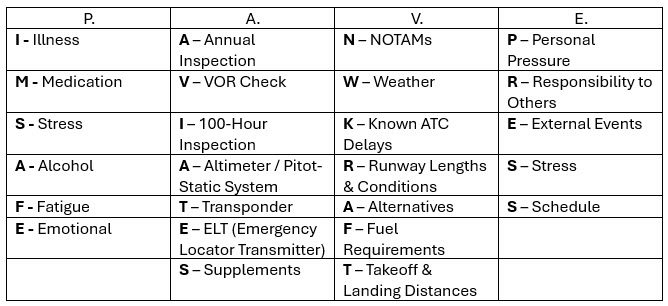
    “Not only do I have a weather and navigation briefing for you, but I studied up on risk management and thought you would like to hear what I learned.” He stood at the front of the room, uncapped a marker, and in large block letters wrote one word on the whiteboard: PAVE.

    Wow, I thought to myself. A student pilot briefing me on the PAVE checklist. We have discussed PAVE, but have not gone into great detail. Let’s see where this is going.

    Ethan looked at me and said, “Alright, I’m the PIC, the pilot in command of this flight, and I’m safe. Before we talk about anything else, I need to confirm that I’m in a safe condition to fly.” Beneath the letter P, he wrote IMSAFE vertically and began working through each element.

    Looking back at me, he pointed to each letter as he wrote each word and explained, “Illness: No symptoms, I am feeling great! Medication: I have not taken anything. Stress: Moderate due to the excitement of embarking on this cross-country alone. Alcohol: None consumed. Fatigue: I had a good night’s sleep after finishing this briefing.” Smiling at me. Then he continued, “Emotional: I am focused but slightly nervous.”

    I nodded. His assessment seemed to be honest.

    Pointing to the letter A, Ethan looked to me and said, “A stands for airplane. I was able to find all the information about the airplane in the maintenance logs. Brittany, at the front desk, was kind enough to show me where they were and how to read them.  “Anyhow, before I am allowed to take this flight, I have to ensure the aircraft is airworthy. With that, I have to ensure the aircraft.” Pointing to the A in aviates, “has had an annual inspection.” Again, he ran through each item one by one, writing the term that each letter represented.

     “Annual inspection completed last month.” Pointing to the letter V, he said, “VOR check within 30 days if using the airplane in IFR conditions, which I have no intention of doing at this time.” He said with a smile, 100-hour inspection, due in 20 hours. The altimeter and pitot-static system inspection must be completed every 24 months; this was completed during the annual inspection. Transponder, good. ELT, inspected two weeks ago, and all of the supplements are current, including the GPS database.”

    He paused for questions. I intentionally offered none. His confidence grew.

    “The next letter in our PAVE checklist is V. and, believe it or not, V stands for environment. The ‘en’ is silent… Vironment” he stated with a smile. “Here we have another acronym, NWKRAFT.” Ethan then wrote NWKRAFT vertically beneath the V on the whiteboard.

    NOTAMs checked. No runway closures along my route. I reviewed the weather, and it is forecasted to be mostly clear with light winds, but there is a potential for afternoon storms along the route. I should be back here before those storms develop. Winds aloft are manageable. I do not need to worry about ATC delays since I am VFR. The runway lengths at both airports exceed my takeoff and landing requirements by a wide margin. I looked at a few alternates along the route. Fuel, I planned 90 90-minute reserve. Takeoff and landing distances already calculated and exceed performance requirements.”His logic was sound. His mitigation regarding afternoon storms showed he understood that conditions today were not static.

    Ethan continued, “Finally, we reach the E in our PAVE checklist, which stands for external pressure. This acronym assists in recognizing and managing psychological and operational pressures that could cause unsafe decisions.” He then turned to the whiteboard and wrote ‘PRESS’ vertically below the E. Looking at me and pointing to the whiteboard, he said, “PRESS,’

    As he wrote the word for each letter, he explained. “I have no personal pressure to complete this flight. Responsibility to others, just you.” Looking at me, “because I want to perform well. No external events are pushing me to hurry. Stress is minimal. Schedule pressure is low since I planned for plenty of time before the weather builds.”

    When he finished the PAVE briefing, he capped the marker, stood next to the whiteboard, and looked at me. “So that is my overall risk assessment. What do you think?”

    “This is impressive, Ethan,” I told him.

    Taking a seat, he said, “Now I’d like to review the FRAT.” He handed me a printed copy of the FAA Flight Risk Assessment Tool, which can be found at (https://www.faa.gov/general/flight-risk-assessment-tool-frat-faa-safety-team).

    He had scored each item thoughtfully, not simply choosing the lowest values. Weather earned a mild risk score due to forecast convective development. Pilot experience added a small risk factor because this was his first solo cross-country. Each score was justified, and the total fell solidly into the green.

    Now it was time for me to ask thought-provoking questions.

    “Ethan, let’s say halfway to your destination, the scattered clouds begin building ahead of schedule, yet the cloud bases remain high. The visibility forward looks reduced. What do you do?”

    Rather than jumping to an answer, he folded his arms on the desk and then responded.

    “I’ll turn around. I’m not going to continue hoping it gets better.”

    “Good.” I pushed further with another question.

    “Your outbound leg is east. The weather typically comes from the west. What if you see the storms building on your return leg?”

    Ethan responded, “I’ll land and give you a call.”

    “What if your fuel burn ends up higher than expected?” I asked

    Ethan responded, “I land at my planned alternate, top off, reassess the weather, and continue only if conditions support the flight. But with my 90-minute reserve, I should have enough.”

    I asked another question, “What if a TFR pops up mid-flight?”

    Ethan responded, “I will be on with flight following, hopefully they will let me know. I also checked the NOTAMs and will check again before departure, but if something appears en route, I’ll divert around it or land and wait for clarification.”

    In each situation, he demonstrated structured decision-making using the tools he had laid out.

    Then I presented the final complication.

    “You arrive at the airport and find a last-minute text from your family saying they plan to celebrate your accomplishment this afternoon. They’re excited and already making plans. Does that affect your go/no-go decision?”

    He smiled. “I’d like to impress them, but I’m not letting that drive the flight. If the weather or anything else changes, safety wins.”

    That answer told me everything I needed to know. Not because he said the right words, but because he understood the implications of external pressure. That level of self-awareness is a cornerstone of accident prevention.

    I sat back in my chair.

    “Ethan, your briefing was thorough, your risk assessment was sound, and your mitigation strategies were realistic. Before you go, let’s review your navigation plan, fuel plan, and radio procedures. But from a risk management standpoint, you’re ready.”

    His face lit up. He opened his EFB and began outlining the route, performance numbers, and alternate strategies. The preparation he showed today was not just about passing a flight requirement; it was about shaping his mindset for the rest of his flying career.

    FOI Stories

  • TASK B. THE LEARNING PROCESS
    Characteristics of Learning

    Understanding the Characteristics of Learning is fundamental to mastering the Fundamentals of Instructing (FOI), a core component of the FAA Flight Instructor training requirements.

    For proper learning to take place, the lesson must be purposeful, incorporate the results of experience, be multifaceted, and involve an active process (P.R.M.A.).

    “Mayday, Mayday, Mayday”

    Written By R. Maclyn Stringer

    During my second week as a Certificated Flight Instructor (CFI), I learned more about the characteristics of learning than any textbook could teach. What started as a routine training flight became my first real in-flight emergency, not just as an instructor but also as a pilot. When Austin asked me how I knew what to do after the emergency and on the ground, I realized how pilots learn.

    Austin, one of my initial students, was in his second week of training. That afternoon, we were doing what every instructor knows all too well — the slam-and-go marathon. Our practice was at an uncontrolled airfield. After fifteen touch-and-go repetitions, he was starting to feel at ease with the airplane. As we turned crosswind in the pattern, the Cessna 172R suddenly shuddered so intensely that my first thought was that the propeller might come loose.

    I looked at Austin and asked, “What did you do?”
    “Nothing!” he said, wide-eyed and releasing the controls.
    “My aircraft,” I replied.

    The throttle remained fully forward, and we had power, but the vibration was severe. We were about 500 feet AGL, with rising terrain ahead and mostly flat grassland below, dotted with a few scattered houses, which I knew I could navigate around. I keyed the mic and announced over CTAF: “Mayday, mayday, mayday.” Then I turned us back toward the runway in what we know as the impossible turn, hoping that partial power would keep us on course to the runway.

    I heard the pilot of the RV-7, which was on final for runway 29, announce, “Going around.”

    With my mind racing, I couldn’t recall the number of the runway on which we were landing. “We are landing on the runway… opposite 29!” A short time later, as I focused on the threshold of the runway, I announced “11!”

    I remember the RV-7 pilot continuing to handle air traffic control. He announced on Unicom that a plane was making an emergency landing on runway 11 and instructed others in the pattern not to land. I then heard a calming comment, “The runway is yours.” As I turned onto my short final and realized we would reach the runway, I noticed I was going too fast, had no flaps deployed, and faced about a 10-knot tailwind. I fully extended the flaps and floated down the runway, feeling as if it would last forever. As the thousand-foot markers on the far end of the runway approached, we touched down, applied the brakes, and stopped before the runway’s end. Did I perform the maneuver perfectly? No. Did we walk away with the airplane intact on the runway? Yes. Were lessons learned? Definitely.

    A post-flight inspection identified a blown cylinder, which cut power by almost 50%. We were lucky, but the experience taught me lessons that transformed my learning and, as a CFI, my understanding of the learning process.

    I tell this story to each of my students to emphasize the importance of knowing their emergency procedures during all phases of flight. I instruct them to be familiar with the actual altitude of 1,000 feet AGL during takeoff. During an emergency, there is no time to calculate the altitude, so they must know it and announce it during their takeoff brief.

    1. Learning Is Purposeful

    The FAA reminds us that students are goal-oriented. They learn best when the lesson clearly connects to something significant. That day, survival was my main goal. My attention focused solely on the immediate task of landing the airplane safely.

    When I retell this story to students, I begin with that purpose. I explain that every procedure, from memorizing 1,000 feet AGL as the decision altitude after takeoff to briefing on where to land in case of power loss, exists for a reason. When my students brief their own takeoffs now, they don’t just recite numbers. They understand why that altitude matters, why they won’t make a turn more than 30 degrees of bank, and to know the terrain around the airport. The purpose is clear: have a plan before the pressure arrives. Purpose transforms routine actions into meaningful ones, which aids in retention.

    2. Learning Is a Result of Experience

    Real learning occurs through personal experience, often the difficult way. The engine’s shaking, strange noises, and the shock of discovering it wasn’t running properly have ingrained the engine-out procedures into my memory. Reading hundreds of pages about engine failures is valuable, but experiencing one firsthand taught me more than any book could.

    When I teach emergency procedures now, I focus on building that same sense of experience in a safe environment. Starting the emergency at a high altitude lets the student concentrate on the critical tasks of flying, navigating, and communicating before troubleshooting the problem. At 5,000 feet AGL, I reduce power to idle and tell the student, “You’ve lost your engine, get us back to the airport.” They quickly realize that experience feels very different from theory. They learn how stress impacts their decision-making, the importance of airspeed control, and how planning ahead can buy valuable seconds. Almost every time, the student looks down at their iPad and, in doing so, increases airspeed. I advise the student to reach their best glide, or they will not reach the airport. 

    3. Learning Is Multifaceted

    In the cockpit, learning occurs on multiple levels. During this incident, there was a cognitive component: identifying the problem and devising a plan. The psychomotor aspect: accurately adjusting pitch, bank, and power. The Emotional Layer: Handling Fear and Staying Focused. And the social component: communicating with my student and hearing the reassuring voice of the pilot who cleared the pattern.

    As a flight instructor, I have come to understand how we acquire knowledge through multiple channels, both intellectually and emotionally, physically, and socially, often simultaneously.

    In my simulated-emergency lessons, I highlight those four dimensions:

    • Think: What’s the cause and the plan?
    • Feel: What emotions surfaced, and how did you control them?
    • Do: How did your hands and feet respond?
    • Communicate: How did you coordinate with ATC and your passenger?

    When students reflect on all four, they see learning not as a checklist but as a complete human process.

    4. Learning Is an Active Process

    That emergency landing exemplified active learning. There was no time to absorb information or wait passively for instructions. I was fully engaged, mentally and physically, in solving the problem.

    Today, I design lessons that demand the same level of engagement. During our simulated power-off landing exercise, I don’t tell the student exactly what to do; I ask questions and guide them to the best answer. They must decide: What’s their best glide? How to communicate with others in the pattern. When to turn base? Are we going to make the runway?

    Active learning turns theory into hands-on experience. When students realize their decisions influence the result, they start thinking like pilots actively piloting the aircraft instead of passengers passively letting it happen. During training, when students face their own “controlled emergencies” to a successful outcome, I observe the same moment of insight that transformed my perspective.

    Students have told me several times that this lesson is one of the more enjoyable lessons because they actually understand the importance of getting the procedure right.

    FOI Stories

  • TASK A. EFFECTS OF HUMAN BEHAVIOR AND COMMUNICATION ON THE LEARNING PROCESS

    ELEMENTS OF HUMAN BEHAVIOR – DEFENSE MECHANISMS

    The FAA discusses several standard psychological defense mechanisms in the Aviation Instructor’s Handbook (FAA-H-8083-9B) under the section titled “Defense Mechanisms.” These mechanisms—repression, denial, compensation, projection, rationalization, reaction formation, fantasy, and displacement—are explained to help flight instructors identify typical emotional responses that students may display when faced with learning difficulties or stress.

    The instructor needs comprehend CFI teaching techniques which allow them to understand and support emotional intelligence in the cockpit. They must recognize these behaviors early and respond with empathy, clarity, and structured feedback. The instructor should avoid being confrontational since defense mechanisms are often unconscious reactions to perceived threats or failure.

    “Steep Turns And Stalls”

    R. Maclyn Stringer

    I have been flying with my student Nick for a few weeks. From our initial discovery flight together, I noticed that he was somewhat anxious about flying. I was unsure whether it was due to a fear of heights or if he did not believe an airplane could fly. Nick told me he wanted to get his private pilot certificate, not because he was chasing a dream to become a world-class airline pilot, but because he just wanted to be a guy who could fly.

    For our first flight together, I introduced Nick to the Cessna 172R. As pilots know, the 172 is an easy and forgiving airplane, one of the best for training new pilots. Nick seemed at ease as I walked around the aircraft, pointing out items we examined from the checklist before the flight. Flaps and ailerons, the tires and brake pads, fuel and oil, etc. The components that keep pilots safe. He nodded along calmly, hands in his pockets, listening intently. He didn’t look anxious or excited.

    After the preflight was completed, I invited Nick into the cockpit, described the internal preflight procedure, and explained how to start the engine. I asked if he wanted to give it a try. Nick nodded yes and took the keys.  Inserting the key, he turned it, cranking the starter, and the engine came to life. He reduced the throttle and adjusted the mixture as I explained. I showed him how to taxi, and we were on our way. The first time taxiing an aircraft is an exciting time for any first-time aviator as they overcorrect the rudder input and perform S-turns down the taxiway. As we prepared to take off, I asked Nick if he wanted to take control while I talked him through the process. He immediately responded with a distinct and deliberate “No!” as he let go of the yoke and placed his hands firmly on his legs. We received our takeoff clearance for 30R. I eased the throttle forward, and we began to roll down the runway.

    As I sat calmly in the right seat, rolling down the runway and explaining what I was doing, the airplane reached rotation speed, and I pulled back slightly on the yoke to allow the nose wheel to lift off the ground. Usually, I would say the age-old aviation mantra of takeoff is optional; however, landing is mandatory. Not this time. I could see that humor was not going to be heard by Nick. As the airplane became airborne, from the corner of my eye, I noticed Nick’s hands clenching his legs while, at the same time, he pushed his rear end into the back of the seat as if he was waiting for the plane to come to a sudden stop. He had an expression on his face, wondering and possibly regretting what he had signed up for.

    “You alright?” I asked over the headset, trying not to smile.

    “Yes,” he said, jaw clenched and eyes forward, as if saying anything more might let the plane know he wasn’t entirely on board with this whole “defying gravity” thing.

    As we departed the pattern to the northeast, the airplane smoothly climbed into the brisk morning sky, with the sun shining on our faces. Below, the land unfolded like a tranquil quilt of green and gold, patches of circular and rectangular fields broken occasionally by reflective bodies of water. But inside the cockpit, Nick felt anything but calm.

    After reaching our cruising altitude, I asked Nick if he wanted to take the controls. Nick timidly and awkwardly took the yoke in his hands. I do not think he could have gripped it any tighter. I told him to relax and explained how to level off, which he did pretty well for the first time in a small airplane. However, I couldn’t get him to loosen that jar-opening grip from the yoke.

    We flew straight and level for several minutes. Nick’s hands barely moved. He was focused with his eyes out the front window. I explained how the airplane turns, then instructed him to make a left turn. Knowing a new student would only use the aileron to turn, I managed any rudder input required. He nervously banked to a 10-degree turn. I slightly added pressure to turn the yoke, providing more bank and back pressure, and then I saw the fear on his face. Nick let go of the yoke and began to slide his body towards me. With each increase in bank angle, his body moved further from the left door. Any more side movement and Nick was going to be on my lap. I seriously think that he thought the door was going to open, and he was going to fall three thousand feet to the ground below. I configured us back to straight and level flight so that Nick could regain his nerves. By the end of the first flight, we finally managed about twenty degrees of bank without him feeling too uncomfortable.

    At one point, I told him that we would have to perform a 45-degree bank turn. His immediate response was “Why?” After chuckling internally, I explained that sometimes a steep turn is required to get you where you want to be and that it is also a part of the final check ride. Nick was not thrilled.

    Throughout the spring, flying with Nick was enjoyable. He wanted to learn how to fly and get over his fear. We scheduled early morning, 5 AM lessons, in the air before the control tower opened and well before any convective activity. We spent most of our time controlling the aircraft in cruise flight, climbing and descending while making ten to twenty-degree banked turns, just trying to get him comfortable.

    There were times in the pattern, while banking the aircraft at thirty degrees, that Nick thought the airplane was banked too aggressively. He would raise his legs as if trying to get into a fetal position and extend his arms over his left shoulder, looking to grasp an assist handle. One time, while turning a steeper base to final, he nervously stated that this is where people die! He explained that he had watched videos of people stalling in the base to final turn and crashing. I told him that he should stop watching airplane crash videos and watch the videos that teach how to fly airplanes properly. I never had to worry about Nick overbanking in the pattern.

    REPRESSION

    From our first flight, it seemed that Nick was unconsciously repressing unpleasant or traumatic memories from the past.  If Nick truly wanted to be a pilot, I had to do whatever it took to make him comfortable in the air.

    During one of our ground lessons, we discussed aerodynamic stalls, the reasons for performing them, and how to react to them. I also explained, in the mildest manner possible, the concept of spins, their dangers, and the P.A.R.E. recovery process.

    With Nick at the controls, we took off for what I knew would be a challenging day of flight training. I had to teach him how to stall in the air. After completing our clearing turns, I again explained what a stall was and how we would perform it. I explained the stall warning horn, the buffet, as well as a full break.

    As we set up for the maneuver, I told Nick to put his hands on the yoke and follow me through the procedure.  “Power idle, point the nose down slightly as if we are coming in for a landing, then slowly pull the nose up. Here we are bleeding off power and airspeed.” As I pulled back on the yoke, I was doing my absolute best to keep the wings level and the nose of the aircraft straight. The last thing I wanted to do was to have Nick freak out during his first stall. For Nick, I think the procedure was taking forever. I could see him pushing his butt further into the seat. The stall horn finally buzzed. I lowered the nose, advanced the power, and we recovered.

    After he had calmed down a bit, I asked if he was ready for a full break. He nervously said yes. I am sure it took every bit of faith in me that we would not spin out of control. In retrospect, I am pretty sure that Nick’s most significant fear stemmed from watching too many videos. He thought the wings would roll over, and we would enter an uncontrollable spin.  Visions of the airplane diving toward the ground, with the two of us spinning toward a collision with the earth.

    DENIAL

    Before entering the maneuver, with an understanding of his illogical physical behavior when fear arose, I looked over to Nick, knowing how afraid he was, and told him to sit there and “Don’t touch me.”

    I pulled back on the yoke, raising the nose of the aircraft. The stall buzzer sounded, and we felt a slight buffet. Then, as expected and briefed, the nose began to fall straight down towards the horizon. In Nick’s mind, we were pointed directly to the ground. He let out a nervous exclamation of “Woo, woo, woo!” then grabbed my left arm, turning the yoke, causing the airplane to bank from a straight nose down to a steep left turn. Feeling an imminent spin progressing, I elbowed Nick in the chest with my left arm, breaking free from his grasp, and then controlled the attitude with my right. I quickly pushed the throttle in with my left.

    Nick exclaimed, “You said the nose would fall straight down through the horizon!”

    I responded, “It would have, had you not grabbed my arm!” trying to keep my cool.

    Nick countered, “I did not grab your arm!”

    Yes, you did.” I replied, thinking I could probably show the claw marks on my skin under my long-sleeved shirt. He was displaying a clear sign of denial. Nick refused to accept the fact that he had pulled on my arm, causing the airplane to roll.

    COMPENSATION

    I told him that we would not be performing any more stalls today, and we continued our lesson.

    “Straight and level flight. I have that down,” Nick said, compensating for his weakness in the stall recovery.

    I looked towards Nick after hearing his self-assuring tone. “Nick, you are not a bad pilot.”

    He continued flying straight and level, not saying a word. “You do perform straight and level flight well, though,” I said, hoping to relieve some of his tension.

    REACTION FORMATION

    As our flight training continued, forcing a chuckle, Nick said, “Well, next time we do a stall, we’ll push this thing into a spin for a couple of rotations, then pull out. That sounds like fun, right? We will show the plane who’s boss.” 

    Knowing how uncomfortable Nick is whenever the plane is not in straight and level flight, I thought to myself that he was displaying a textbook case of reaction formation, trying to convince himself that he has no fear of stalls.

    “Really, you’re ready for another stall?” I asked.

    “Sure am,” Nick said with a smirk on his face.

    “We will make sure we get one in during our next flight,” I responded. “For now, let’s head back to the airport.”

    RATIONALIZATION

    As we navigated our way back to our airport, Nick remarked, “You know, if we flew better, higher-performance aircraft, the plane would not stall like that. These Cessnas just aren’t good at stall recovery.” Nick said in an attempt to rationalize his stall recovery behavior.

    I responded, “Nick, the 172 is one of the easiest and most forgiving airplanes for students to learn in. Why do you think it is the plane’s fault?” Nick did not say a word. “Stall recovery just takes practice and confidence that the airplane will do what you want it to do,” I said, hoping to keep his motivation for aviation alive.

    PROJECTION

    After that exchange, our flight back was quiet. A nearly sterile cockpit, which allowed Nick time to think. “I would not have overreacted had you not attempted to put us into a spin and scare me.”

    Raising an eyebrow, I quickly thought to myself, how am I going to respond to that remark without sounding confrontational? Knowing I did not intentionally roll the aircraft. Nick grabbed my arm. I thought it best not to react to his projection.  Instead, I replied, “Good job bringing us back to the airport safely. When we land, we can talk about what we can refine.”

    FANTASY

    Nick took the controls for landing. It was not a great landing, but it was safe. He taxied the airplane to parking and went through the shutdown checklist. I could see the frustration drawn on his face. He took his headphones off his head and looked towards me, “You know, I don’t even know why I’m trying to do this, maybe I’ll just go into truck driving.” His voice carried a wistful tone, evoking a fantasy of an easier path rather than confronting the challenges ahead.

    I let the silence settle for a moment before replying. “Learning to fly is not easy. A lot of it is mental, and you’ve already shown you can push through. You used to be unable to complete a steep turn. Now look at you. I think you think today’s experience was worse than what it was.”

    DISPLACEMENT

    Nick climbed out of the cockpit, tied down the airplane, and began walking towards the school. With his head down, he kicked an orange safety cone near the hangar in an act of displacement, channeling his disappointment with himself into a harmless object. He reached down and put the cone back where it belonged. As he straightened up and we continued our walk towards the hangar, I told him, “Every pilot I have trained has been nervous about stalls. Together, we can help you overcome your fear of them. You may still be apprehensive of them, but once you have the recovery maneuver solidified in muscle memory, they won’t be as bad.”

    As we debriefed, I could see the tension easing in Nick’s head. For a few moments, I thought he was ready to quit flying. Unfortunately, this happens to many students, and I was hoping he wouldn’t be one of the statistics to quit because of how emotionally demanding flying can be.

    For me, it was another day balancing aviation instruction with the art of navigating human nature, ensuring students become skilled pilots and resilient individuals.

    FOI Stories

  • R. Maclyn Stringer

    TASK A. EFFECTS OF HUMAN BEHAVIOR AND COMMUNICATION ON THE LEARNING PROCESS
    ELEMENTS OF HUMAN BEHAVIOR – HUMAN NEEDS

    In Task A of the CFI ACS Airplane, the CFI candidate must discuss the effects of human behavior and communication on the learning process. Understanding human behavior helps explain how and why people act as they do while working to satisfy personal needs. In aviation training, this knowledge helps instructors craft lessons tailored to different age groups, backgrounds, and personality types. Effective instructors celebrate students’ milestones, such as their first landing, their first solo, and earning their pilot certificate. During dips in motivation or learning plateaus, the instructors introduce new challenges, remind learners of their objectives, and reassure them that plateaus are normal, helping the student remain engaged, confident, and steadily progress toward their aviation goals and growth.

    “Flight Of Understanding”

    Written By R. Maclyn Stringer

    It was a beautiful, blue-skied, crisp fall morning. With a large coffee in hand, I stepped onto the ramp, enjoying the sunrise and the view of the sun shimmering from atop the wings of our fleet with the mountains as a backdrop. I thought to myself, this scene never gets old.

    I like to complete my preflight of the plane before my students arrive, checking every surface, every hinge, every fluid level. It gives me time to think, without the distractions of fellow instructors and students buzzing around: just me, the airplane, and the morning light. Today, I was checking one plane particularly closely. Cristina has a check ride today, and I want to ensure the DPE does not find anything wrong with the airplane. Issues with the aircraft can be resolved. Cristina’s knowledge and performance; that’s on her. 

    After inspecting the airplane and calling for fuel, I sat on the bench outside the maintenance hangar with the sun on my face, sipping my coffee.

    “Good morning, Mac.” I heard cheerfully over my shoulder.

    Looking towards the voice, I saw Cristina early, as usual. She carried her headset in one hand and a backpack in the other, eyes bright with anticipation.

    “Morning. You ready?” I replied.

    She nodded. “Nervous… but ready.”

    Moments later, her DPE arrived. They shook hands and walked towards the office. As they walked away and their voices faded, my mind drifted down memory lane. I recalled the first day Cristina and I flew together on that warm June morning. Cristina had never been in a small plane and was eager to learn. I reflected on the journey, recognizing how deeply my role as an instructor was tied to the fundamentals of human behavior: people need encouragement, tailored challenges, and the assurance that setbacks are a natural part of progress.

    As a professional flight instructor for many years, I’ve come to understand that each student brings a unique story to the cockpit, although a shared dream of flight drives them all. As instructors, we often focus on airspeed, altitude, and bank angle. Our job isn’t just about teaching someone how to operate an airplane; it is also about understanding how and why people function the way they do. It’s the instructor’s job to meet them where they are, mentally, emotionally, and technically, and guide them through the psychological journey of becoming a pilot, overcoming fear, building confidence, and pushing through inevitable moments of self-doubt. Overcoming their fear of screwing up, the frustration of slow progress, and the nagging voice that says, “Maybe I’m not cut out for this.” Our role is not just to keep students safe in the air, but also to help them manage what was going on inside their heads.

    My teaching framework is not just a checklist of tasks. It is based on Maslow’s hierarchy of needs, meeting the students where they are and progressing upward from basic physiological needs to the pinnacle of self-actualization.

    PHYSIOLOGICAL NEEDS

    Every student starts with the basic needs. Sleep, hydration, and mental focus, those things matter, especially on hot summer days. Cristina was no different.

    As we continued our lessons through the summer, whether on the ground or in the air, I would ensure she was in a good mental state. I recall several Saturday mornings when she seemed not to have gotten enough rest from a fun Friday night.  “Did you sleep?” “Did you eat?” “Feeling okay?” were questions often asked. Numerous mornings, I’d hand over a water bottle before we started the engine. I learned long ago that if a student is dehydrated, overheated, or distracted, they won’t retain anything. It’s a waste of a lesson and their money.

    SAFETY NEEDS

    I worked to make Cristina feel safe in her learning environment. We started every session with a pre-flight briefing, walked through risks, briefed on emergencies, and built confidence before departing the ramp. Stalls were her least favorite maneuver. She often said there is no good reason for a plane to fall from the sky. She clenched the yoke a bit tighter every time we set up for one. However, I made sure we practiced them every lesson, not to push her, but to make the maneuver a part of her muscle memory, thereby relieving much of the anxiety. Familiarity breeds confidence.

    BELONGING AND ENCOURAGEMENT

    Our flight school has something special. Management and instructors alike work to create an environment that is both professional and welcoming. It’s the kind of place where students stay to hang out after their lesson ends.

    Cristina fit right in with her bubbly, charismatic, and naturally social demeanor. I encouraged her to chat with other students and instructors in the lounge, to compare notes, and to hang around for debriefs that weren’t her own to learn from others. The mentally challenging world of aviation can be lonely, with many hours spent away from others as we study, but a strong peer network can carry us through.

    SELF-ESTEEM, PERSONAL GROWTH, AND RESILIENCE

    Cristina enjoyed celebrating both big and small wins. Her first butter landing and when she finally nailed a crosswind touchdown in gusty conditions, she all but high-fived herself on rollout. When she struggled, got frustrated, and became impatient, we tackled things in smaller pieces. I’d set up manageable challenges, such as simulated engine failures or working simple navigation under the hood. Every success rekindled her confidence.

    A defining moment for Cristina, like most others, was the completion of her first solo flight. Standing on the runway, I watched her plane touch down smoothly. When she shut down and stepped out, her eyes were wide. “I did it,” she said, almost in disbelief.

    “That you did,” I said. “This is your moment, now let’s get a picture.”

    I admit, there is a lot of pride in being an instructor when a student first solo’s.

    COGNITIVE AND AESTHETIC

    As training continued, I watched her focus shift from simply rote memorization and learning how to perform tasks to wanting to know why they mattered. Her cognitive needs grew, sparking intellectual curiosity about procedures, aerodynamics, and weather. She wanted to learn the “Why?” in what was being learned.

    Cristina connected emotionally with flight. For her, a smooth landing wasn’t just a technique. It was poetry. For her, a perfect turn was a choreography. Her aesthetic need for compliments wasn’t ego-driven, it was affirmation that she was mastering both form and function.

    It took me several years as an instructor to learn that being complimentary and affirming to students helped improve their mental state and enhance their learning. As flight instructors, we need to transform lessons from technical drills into meaningful, personal experiences by addressing cognitive and aesthetic needs. This approach produces more capable pilots and fosters lifelong learners who find joy and purpose in aviation.

    SELF-ACTUALIZATION, MILESTONES, AND BREAKTHROUGHS

    Around lunchtime time Cristina stepped out of the airplane with a large grin on her face and confidently walked towards me. “Who’s the newest pilot?” she said, pointing her fingers at herself.  She looked proud, resilient, and transformed. She was on top of the world, as if she had reached the peak of her journey and stepped into what she was truly born to do. To fly the majestic skies free as an eagle.

    A LESSON IN HUMAN BEHAVIOR

    Upon Cristina receiving her private pilot certificates, I reminded her, “Every flight teaches you something, not just about flying, but about yourself. Keep learning, keep growing, and keep flying.” Flight training had changed her, not just in the air, but in life. She became more patient, deliberate, and far more confident in her abilities.

    As for me? I felt the deep satisfaction that comes from doing this job right. It’s not just about creating pilots. It’s about helping people discover the strength they didn’t know they had. And as I watched her take off on her first flight as a certificated pilot, I smiled. Although I may have been the instructor, I learned just as much from the journey.

    FOI Stories